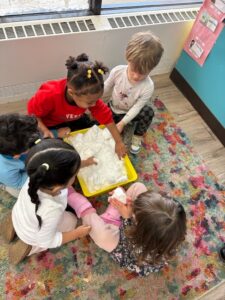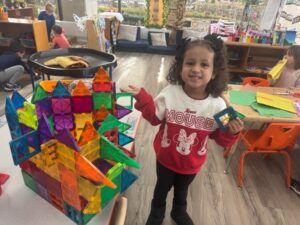
Confidence in young children does not appear because someone tells them they are doing a good job. It grows quietly, through experiences that let them act, observe, adjust, and continue at their own pace. In a Reggio-inspired preschool, confidence is shaped by trust. Children are trusted to explore their ideas, take their time, and decide how deeply they want to engage.
Rather than starting with instructions, we begin with curiosity. When children are given room to follow what draws their attention, they begin to see themselves as capable thinkers. That feeling of capability becomes the foundation for confidence.
Exploration Is the Starting Point
In a Reggio-inspired preschool, learning begins with hands-on discovery. Children investigate materials without being told what the final result should look like. They stack, sort, arrange, move, and rethink. Some children jump right in. Others watch closely before participating. Both approaches are valued.
When children are not rushed or corrected too quickly, they feel safer experimenting. They learn that mistakes are part of the process, not something to avoid. Over time, this freedom builds confidence because children are allowed to trust their instincts.
The Space Encourages Independence
The environment plays a quiet but powerful role. Materials are arranged so that kids can access them. Tables, rugs, and work areas invite different kinds of activity. Nothing feels off-limits.
In a day care learning center that follows Reggio-inspired practices, children are encouraged to make choices throughout the day. Choosing materials, deciding how long to stay with an activity, or working alone versus with a peer all reinforce independence. Each choice strengthens a child’s belief in their own judgment.
Adult Support Without Control
Adults stay present, but they do not direct every step. They watch, listen, and thoughtfully react rather than trying to solve problems for kids. Sometimes support looks like asking a simple question. Other times, it means giving space.
When children work through challenges on their own, even small ones, they gain confidence. They discover that problem-solving can be done calmly and that effort is important. This kind of guidance helps children feel supported without feeling managed.
Confidence Comes From the Process
The emphasis in Reggio-inspired classrooms remains on children’s thought processes rather than the final product. A project doesn’t have to have a specific appearance. What matters is the thinking, experimenting, and persistence behind it.
Children who are allowed to work without constant evaluation become more willing to speak up and share ideas. They take risks because they are not worried about being wrong. Confidence grows naturally when children feel respected.
Skills That Extend Beyond Preschool
Children who spend time in this kind of environment often bring those habits with them as they grow. They become more comfortable asking questions, trying again when something does not work, and speaking up when they have an idea. These behaviors support learning long after the preschool years, because the child has learned to trust their own thinking.
In our Reggio-inspired preschool in Tarrytown, NY, confidence is not taught directly. It develops through exploration, patience, and trust.
Frequently Asked Questions
How does exploration help children build confidence?
Exploration allows children to make decisions, solve problems, and learn from experience, which builds trust in their own abilities.
Do children still receive guidance in this approach?
Yes. Adults observe closely and offer support when needed, but they avoid taking control away from the child.
Can Reggio-inspired practices work in a day care learning center?
Yes. Many day care learning centers successfully use this approach to support independence, curiosity, and steady confidence.