
Categories
daycare

Meals, Allergies & Nutrition: What to Ask Your Tarrytown Day Care Center

When parents tour day care centers in Tarrytown, they often ask about curriculum, safety, or play spaces. But one topic that deserves just as much attention is food. How does the center plan meals? What if your child has allergies? And how do teachers make mealtimes calm and positive for everyone?

At Discovery Village, we talk about food often because it’s such a big part of a child’s day. Little ones try new foods, and learn routines that often-become family habits at home.


How Are Meals Planned Each Day?

It’s a good idea to ask how your child’s meals are chosen and prepared. Are they balanced? Fresh? Age-appropriate? The answers to these questions will tell you a lot about how a daycare handles the nutrition of enrolled kids.

At Discovery Village, our on-site full-time chef prepares nourishing, healthy  meals and snacks that help children feel satisfied and ready to learn. A healthy breakfast, lunch, and afternoon snack is included in the cost of tuition. The goal of our day care center is not just to feed but also to teach healthy habits that last. 


How Are Allergies and Special Diets Managed?

If your child has allergies, you’ll want to know how the staff stays alert and organized. Do they keep allergy lists visible? Are teachers trained on what to do if a reaction happens?

Our team at Discovery Village treats allergy management as a shared responsibility. We communicate closely with families, keep clear records, and make sure every teacher understands each child’s needs. 


Do Kids Learn About Food, Too?

Children love to explore. Sometimes that means trying new fruits, learning where food comes from, or even helping to unpack groceries during a class activity.

We see food as part of learning and a chance to talk about colors, textures, and kindness. 


How Your Daycare Coordinate with Families for Nutrition

At Discovery Village, we know that children do best when families and teachers work together. Mealtime habits often start at home, so we like to keep an open conversation with parents about what children enjoy, what they’re trying, and what’s still a “maybe later” food. 

Sharing those small details helps us make mealtimes familiar and comforting. Sometimes, a quick note from home like “she tried broccoli last night!” helps teachers celebrate those little wins the next day. It’s that teamwork that helps kids build healthy, happy relationships with food.


Why Meals at Daycare Matter So Much

When children sit together, share food, and feel seen, they build confidence. The kids learn to listen to their bodies, to respect others’ choices, and to enjoy eating healthy food at their own pace.

At our day care center in Tarrytown, we believe mealtime should feel like home, warm, calm, and full of small moments that help children grow.


Frequently Asked Questions

Does your Tarrytown day care center provide meals for kids? 

Yes, Discovery Village works with a licensed dietician and a trusted chef who prepares fresh meals on-site for kids. To check more details about our meal schedule, please visit here

How does your daycare center handle picky eaters?

We encourage kids at our daycare center in Tarrytown to eat without pressure. Exposure, patience, and a bit of playfulness work better than rules.

What if my child has a severe allergy?

We partner with parents to create a written meal plan, and train all staff in allergy management.
Categories
Preschool

How Play-Based Activities Help Preschoolers with Math and Literacy

When parents think of math and literacy, they often picture worksheets or flashcards. But in early childhood, learning doesn’t begin at a desk; it begins through play.

At Discovery Village daycare center and preschool in Irvington, we’ve seen how play-based learning can spark curiosity, confidence, and a love of learning that lasts for years.

Play gives children the freedom to explore ideas, experiment with language, and make sense of numbers in ways that feel natural and fun.


What Is Play-Based Learning?

Play-based learning is learning through play and fun activities, such as when children build towers, sort blocks by color, listen to stories, or pretend to run a grocery store.

Through these playful moments, children develop: 

  • Problem-solving skills
  • Early math understanding
  • Stronger language basics 

… without even realizing they are learning. At Discovery Village, we design our preschool classrooms and daily routines so that learning happens through joy and movement, not memorization. And we assess, not with tests, but through observation. We document the skills children are demonstrating and expand opportunities for them to develop the vital skills needed for success in kindergarten and in life.


How Play Builds Early Math Skills

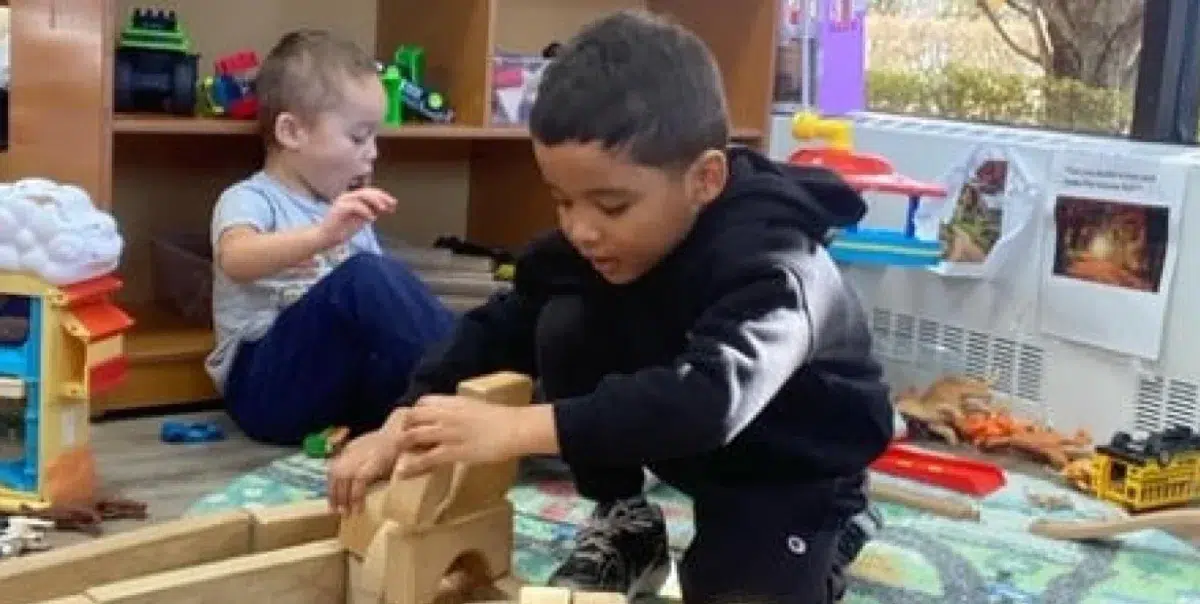
Preschoolers at our center in Irvington learn math without worksheets. They learn it through play. When a child stacks blocks, they start to understand balance, height, and quantity. Teachers observe, engage, and document skills. We then encourage activities that continue to cultivate skills, documenting and sharing progress with parents.

When children set the table for friends or pour sand into buckets, they’re comparing amounts, recognizing patterns, and developing spatial awareness.

At Discovery Village, math finds its way into our day without our children even noticing. Preschool teachers might count steps with the children on the way to the playground, talk about how many cups we need for snack time, or point out circles and squares in a favorite storybook. It’s never a formal lesson, just real moments that make numbers part of play.


How Play Strengthens Literacy and Language

In our classrooms, language improves and grows through everyday play. It happens when children act out stories when playing with friends, sing their favorite songs, or chat while building a pretend store. None of it looks like a “lesson,” but there’s so much learning tucked inside. 

You might see children:

  • “Reading” a storybook to a stuffed animal
  • Making up a story about a dragon or a trip to space
  • Finishing rhymes during circle time
  • Talking through what happens first, next, and last in their play

All of these little moments build early literacy, listening, sequencing, and finding the right words to share ideas.


The Power of Teachers in Play

At Discovery Village, play isn’t something we stand back and watch. Teachers in our Irvington preschool sit with the children, listen to their stories, and notice the small things: the moment someone shares a block, solves a problem, or finds a new way to build.

Sometimes we ask a question to keep the play going:

    • “What should we try next?”
    • “Do we have enough pieces for everyone?”
    • “How can we make it stand taller?”

Other times, we stay quiet and let the children figure it out. That balance matters. It’s how they learn to think, plan, and speak their ideas out loud.

Play shows us so much about who each child is: how they approach challenges, how they talk to friends, how they light up when something works. 

At Discovery Village, we make every block, story, and song part of a meaningful learning journey.

If you’re looking for a preschool in Irvington that combines play, purpose, and care, come visit Discovery Village.


Frequently Asked Questions

What makes Discovery Village’s play-based approach different?

Our preschool teachers plan purposeful play that blends fun with learning goals. Every story, block tower, and song supports language, math, and social growth.

How can parents support math and literacy at home?

Join in your child’s play! You can count objects while cooking, read stories together, or talk about shapes on a walk. Everyday moments make the best learning tools.

What ages benefit most from play-based learning?

Preschool and pre-K are ideal stages, but play-based learning benefits children of all ages.

Categories
Uncategorized

What a Preschool Day Looks Like for Children in Elmsford

When parents ask what a preschool day looks like, we smile. It’s busy, sometimes loud, and always full of the small things that truly are the big things in life. At Discovery Village – the best preschool program in Elmsford – every day has a rhythm of care, curiosity, and comfort.


Morning Arrival and Play

The day begins softly. Teachers greet each child by name, helping them settle in. There’s time to warm up, talk, and explore. Some children dive into puzzles, others grab crayons, and a few just stand watching for a minute.

We gather together for breakfast, socializing and enjoying nourishing food prepared on site your own chef. It’s then on to our morning meeting where a short song, a story, or a question starts the day. A single comment can begin the morning project. Maybe someone notices rain on the window, and suddenly the class is talking about puddles. These moments spark curiosity and turn ordinary mornings into discovery. Or perhaps we’re already well into an ongoing exploration on an intriguing topic such as architecture or space exploration.


Learning Through Play

Learning here happens in motion. Children paint, build, pour, and sort. A group stacking blocks starts comparing sizes, testing balance, and laughing when it all falls down. Others mix colors to see what new ones appear. Teachers guide, listen, and encourage questions, but don’t rush to give answers. It’s about helping children think for themselves.

While children experience the program as play, projects, exploration, and discovery all day every day, there is a robust curriculum backing the learning. Each child has individualized goals, and we support growth in all the vital early childhood learning domains. Assessments are playful, occurring through observation of students. And parents have access to lesson plans and learning goals through our Teaching Strategies app.

This combination of individualized goals with a play and project based approach backed by a robust curriculum that truly builds vital skills is the reason many families find ours to be the best preschool program in Elmsford. Our lessons grow out of play. Every small activity has meaning, like sharing, counting, talking, and solving tiny problems together. 


Lunch, Rest, and Afternoon

After outdoor play, everyone washes up for lunch. The smell of food mixes with chatter and laughter. Children pour water, pass bowls, and practice polite words. Teachers sit among them, joining conversations that drift from favorite animals to how many green beans are left on a plate.

After lunch, the lights dim and the classroom exhales. A few children sleep almost instantly. Others flip through picture books or watch ceiling shadows. It’s calm, a bit messy, exactly as it should be. The room feels safe enough for children to rest without hurry.

When nap time ends, the day stretches into its final rhythm. Some children finish their morning projects, painting or sorting or building small cities of blocks. Others turn to pretend play or storytelling. By late afternoon, the tables hold more paint than paper. There’s often a moment of thoughtful quiet before the next burst of laughter.

Parents arrive to the sound of small voices sharing their day – what they built, what they painted, what they learned. The room smells faintly of crayons and soap. Teachers share quick updates and warm smiles before the room slowly empties again.

Each day ends the way it began, with connection. The best preschool program in Elmsford isn’t about doing more; it’s about creating space for children to grow, think, and feel proud of what they’ve done.


Frequently Asked Questions

What does a preschool day include?

Children enjoy stories, art, outdoor play, and group projects that build creativity, confidence, and language skills.

How do teachers guide learning through play?

Teachers follow children’s interests, ask thoughtful questions, and use daily play to build skills in math, literacy, and cooperation.

Why do families in Elmsford choose Discovery Village?

Families in Elmsford choose Discovery Village because our classrooms feel calm and personal. Children learn and grow through curiosity, routine, and care every single day.

Categories
daycare

Benefits of Project-Based Play in Daycare Learning Center in Westchester

In a busy classroom, mornings often begin quietly. Children arrive, find their favorite corner, and start to explore. A few build with blocks. Others watch light move across the floor or collect crayons that roll off the table. Teachers walk among them, listening for the small moments that can grow into something more.

At our daycare learning center in Westchester, those moments are where project-based play begins. It isn’t a planned lesson or a task to finish. It’s a way for children to follow their curiosity and turn it into something meaningful.


How Curiosity Becomes Learning

Sometimes a project starts with a question – why does a leaf float or why does paint mix into new colors? Teachers notice these questions and build around them. They might bring in water tubs, brushes, or mirrors. The children gather, talk, and try things out.

Before long, play becomes an experiment. They guess, test, and see what happens. The learning hides inside the laughter. A child is practicing measurement when they pour water into a cup. Building a tower is another way to experiment with design and balance. 


Learning by Doing

When children take the lead, mistakes don’t stop them. Paint spills, towers fall, and ideas shift halfway through. Teachers stay nearby, asking, “What do you think we could try now?” That question opens the door for problem-solving.

A bridge that doesn’t stand the first time turns into something sturdier the next. Each small success builds patience and pride. Parents often tell us their children start to bring that same attitude home, trying things again and again until they work, and enjoying the process along the way.


Growing and Working Together

Project-based play also teaches children how to work with others. They share space, trade ideas, and learn to listen. A quiet child might begin speaking up when planning a group project. Another learns to wait or help a friend.

We often hear that these habits show up at home too. Families notice their children explaining how things work, creating “experiments” in the kitchen, or retelling stories from school. It’s a sign that learning has become part of who they are.


Final Thought

At our daycare learning center in Westchester, project-based play gives children room to wonder, test, and grow. They build ideas with their hands and confidence in their hearts. By following their curiosity, they learn that play and learning can be one and the same, and that discovery can happen every single day.


Frequently Asked Questions

What is project-based play?

Project-based play is an educational approach in which teachers follow the interests of the students and lead them in experiential learning that results in discovery and 

How does it support development?

Project-based play helps children naturally strengthen a wide range of skills, including but not limited to language, math, and science skills while also building patience, focus, and teamwork.

Why do families in Westchester value project-based play?

Families in Westchester value project-based play because it’s joyful and real. Children come home eager to show what they’ve made and talk about what they discovered that day.