Categories
Preschool

How Play-Based Preschool in Sleepy Hollow Helps Children Learn and Thrive

Parents in Sleepy Hollow often want to know what we mean when we say “play-based preschool.” On the surface, it sounds simple: children playing. But when you look closer, you see how much learning is happening. 

At our play-based preschool in Sleepy Hollow, play is not a break from learning. It is the way children learn.


Learning That Doesn’t Feel Like Lessons

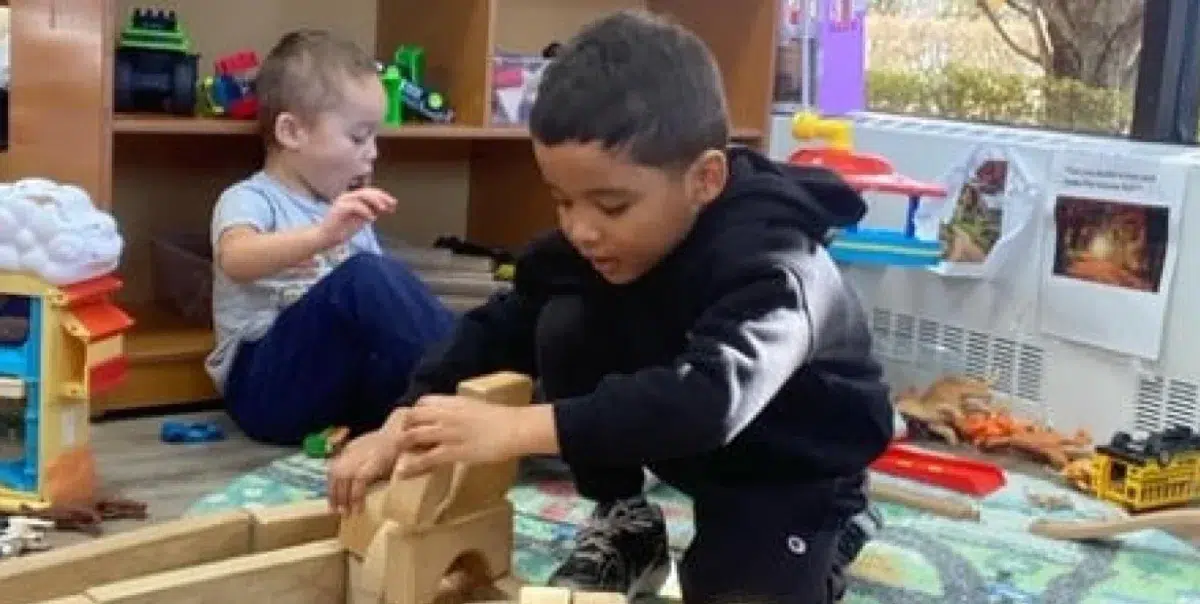
Children are wired to explore. Instead of worksheets, we give them real experiences. A pile of blocks teaches balance and problem-solving. Pretend play in the kitchen corner builds language, patience, and cooperation. A paintbrush in a small hand strengthens the muscles needed for writing later. 

From a child’s view of the world they are playing and exploring all day. From an adults’ view of the world, children are immersed in well rounded learning experiences encompassing the core early childhood learning areas: social-emotional, physical, cognitive, language, literacy, mathematics, science, social studies, and the arts.

Parents have shared how children’s curiosity and knowledge expands dramatically after only a short time at Discovery Village. From blocks, they explore architecture. From hand-washing they discover the wonders of water, branching out into life under the sea, rain clouds, and gardening. By following children’s interests, worlds of possibility open.

To children, it’s just fun. To parents, the conversations and learning children bring home are proof that play builds skills without the pressure of “lessons.”


Social and Emotional Growth

Play is also where children practice being part of a group. They wait for turns, share space, and solve problems with friends. These small things become the roots of patience and empathy.

We see shy children start slowly. First, they watch. Then they smile. Then one day, they join in. Children who once clung to their parents now run to “cook breakfast” with friends in dramatic play. 

Parents tell us they notice changes at home too. Children suddenly invite siblings into games or show more confidence when speaking up.


What a Day Looks Like

Classrooms are arranged for discovery. There’s an art table, shelves of blocks, and a cozy corner for reading. 

Projects are planned by teachers based on the interests of the students. When intrigued by outer space, children may build spaceships out of cardboard boxes. When interested in animals, they might design a farm. Interests are varied and explorations last for as long or as short as they captivate children’s imaginations. 

Each child also has individual goals, and teachers track their progress by observing them playing. There are daily class meeting times when –  through music, movement, and storytelling – children learn literacy and math skills. Teachers also organize daily science experiments and art projects, immersing children in creativity.

Even snack time carries lessons. Pouring milk into a cup (and sometimes spilling) teaches independence and measurement. Sitting together and passing food builds kindness. 

Parents tell us their children bring these habits home: excitedly talking about what they are learning, sharing food at the table, or singing new songs at bedtime.


Final Thought

A play-based preschool in Sleepy Hollow is about far more than play. Through blocks, stories, music, and shared routines, children gain confidence, friendships, and skills that last well beyond preschool. 

Families choose this approach because it makes learning joyful while preparing children for kindergarten and for a lifetime of curiosity.


Frequently Asked Questions

How does a play-based preschool prepare children for kindergarten?

Children practice literacy, math, problem-solving, and cooperation through play. By kindergarten, they are ready for routines, curious, and self-assured.

What does a typical day look like in a play-based preschool?

The day includes outdoor activities, storytelling, music, art, dramatic play, and construction. To make learning feel organic and interesting, teachers design activities around the interests of their students.

Why do parents favor play-based preschool programs in Sleepy Hollow?

Parents prefer play-based preschool programs in Sleepy Hollow because they see improvements in confidence, independence, and friendship. Children develop a lifelong love of learning as they learn new things while having fun.

Categories
Infant

How Sleep and Feeding Are Managed at an Infant Daycare in Tarrytown

Parents often tell us that sleep and feeding are their biggest concerns when considering infant daycare in Tarrytown. It makes sense. Those two routines shape so much of a baby’s day. At Discovery Village, we see sleep and feeding not as tasks to get through but as moments to nurture comfort, growth, and trust.


Sleep in Infant Daycare

No two babies nap the same way. Some drift off quickly, others take longer, and a few resist naps altogether. We don’t force a single routine on every child. Instead, we ask parents about their baby’s rhythm and do our best to follow it here.

Each infant has their own crib, labeled clearly, so it’s familiar and consistent. Teachers create a calm space: soft light, quiet voices, and gentle transitions. Safe sleep practices are always in place: babies rest on their backs, cribs stay clear, and teachers check often.

If a child needs extra comfort, we rock, hum, or offer a pacifier if that’s what the family uses at home. And because parents want to know how their child slept, every nap is logged. Families see exactly when their baby rested and for how long.


Feeding in Infant Daycare

Feeding is just as personal. Some babies eat every two hours, others wait longer between feedings. We prepare bottles of breast milk or formula according to family instructions. Everything is labeled, and offered on the child’s individual schedule.

When babies begin solids, we go slowly. Parents tell us which foods to start with, and teachers introduce them one at a time. Every feeding is written down, time, amount, and any notes, so parents have a complete picture at pickup.

Feeding isn’t only about nutrition. Teachers hold infants, look them in the eye, and speak softly as they feed them. These minor details transform an ordinary bottle into a trusting and connecting moment.


Why It Matters

Sleep and feeding are the backbone of an infant’s day. Good rest supports brain development. Consistent, responsive feeding helps babies feel safe and secure. 

At our infant daycare in Tarrytown, we treat these routines with the same importance as play or learning. By blending safety, care, and communication with families, we create rhythms that help children grow and reassure parents too.


Frequently Asked Questions

How are nap times handled at your infant daycare in Tarrytown?

We follow each child’s routine from home. Babies nap in their own crib, and teachers record times so parents know exactly how their child rested.

How do you manage bottle feeding and solids?

We give bottles of breast milk or formula on the child’s schedule. For solids, new foods are introduced slowly and only with the parents’ guidance.

What makes your approach to infant care unique?

We see sleep and feeding as opportunities for comfort and connection, not just routine care. Our teachers provide warmth, safety, and communication that families in Tarrytown can trust.

Categories
Preschool

What Is a Play-Based Preschool and Why Do Parents in Sleepy Hollow Choose It?

Parents in Sleepy Hollow often ask us, “What exactly is a play-based preschool?” The phrase sounds simple, but the meaning goes deep. A play-based preschool like ours, Discovery Village, is built on the idea that children learn best when through play.

What Play-Based Preschool Really Means

In our project and  play-based preschool, we don’t expect children to sit for long lessons or memorize facts from a worksheet. Instead, their day is filled with opportunities to explore, imagine, and create.

We use The Creative Curriculum by Teaching Strategies,  a comprehensive, research-based early childhood program that supports development across social-emotional, physical, language & literacy, cognitive, science and the art domains. Through hands-on investigations and individualized instruction incorporating creative expression, we align learning with early learning standards.

With Teaching Strategies GOLD, an observation-based assessment tool, teachers track children’s progress, and share the results with families. Instead of using tests, teachers watch and document what children do during everyday activities and play. The tool organizes progress across key areas including social-emotional skills, physical development, language, literacy, math, and more, so teachers can see each child’s strengths, plan next steps for learning, and share progress with families.

From a child’s view of the world, they are playing all day. From an adult perspective, we are carefully tracking milestones, goals, and growth.

You might see children building towers with blocks, acting out a story in the dramatic play area, painting at an easel, or working together on a puzzle.

Each of these activities is an opportunity to build skills.

  • Joining together to build a model of a community with recyclable materials incorporates math, literacy, and social studies.
  • Imaginative play with puppets helps children practice language, literacy, sharing, and cooperation.
  • Art projects incorporating natural and recyclable materials strengthen small muscles in the hands while also supporting children to express feelings and cultivate creativity.

Why Parents in Sleepy Hollow Choose This Approach

Many parents tell us they want more for their children than early academics alone. They want their children to build friendships, develop resilience, and manage emotions. These are the skills that help children thrive not only in kindergarten but throughout life.


What It Looks Like Each Day

In our classrooms near Sleepy Hollow, spaces are carefully arranged to encourage exploration. There is an art corner, a reading nook, and a dramatic play area alongside shelves of blocks, puzzles, and science materials. Teachers weave projects into these spaces, inspired by children’s interests.


Preparation for Kindergarten and for life

There is so much more to a play-based preschool in Sleepy Hollow than simply child care. Through the simple act of play, children explore, create, and develop. Parents here choose this approach because it blends learning with joy, giving children the skills and confidence they need both to succeed in kindergarten, and well into the future.


Frequently Asked Questions

What makes a play-based preschool different from a traditional preschool?

Traditional preschools mostly use worksheets or structured lessons. A play-based preschool with a research based curriculum uses activities like building, painting, and imaginative play to teach the same skills in a more natural way. Our curriculum engages children in activities to develop social-emotional, physical, language & literacy, and cognitive skills, while also immersing children in science and art activities cultivating curiosity, creativity, and a life-long love of learning.

How does play-based preschool prepare kids for kindergarten?

Through play children develop the range of skills needed to excel in kindergarten and beyond. This includes skills in the range of vital early childhood learning domains including  social-emotional, physical, language & literacy, cognitive, science and art.  Our daily rhythm and routines allows flexibility with clarity of what is expected, supporting children to become more independent. They gain confidence from these experiences as they enter kindergarten.

Why do parents in Sleepy Hollow prefer play-based preschool programs?

Families choose this model because it balances care and education. Children build friendships, gain confidence, and develop a love of learning that continues well beyond preschool.

Categories
daycare

Difference between Licensed Home Daycare Services and Professional Childcare Centers

Choosing the childcare program that works best for your family can be overwhelming.  You want nurturing care, opportunities for social-emotional learning, convenient hours, preparation for school in the future and so much more. How is a family to choose?

To begin, there are two main types of care: home daycare services and childcare centers. Both take care of children, but they work differently. Let’s see what makes each one special.


What Is Home Daycare?

Home daycare happens in someone’s house. A caregiver, with assistants, watches a small group of children who play in regular rooms in the house.

The caregiver receives a license from the state. This means they follow rules to keep children safe. Most home daycare services can watch 6-8 children at one time.

Home daycare feels like being at a friend’s house. Children of different ages play together. Babies might nap while older children play together.


What Is a Childcare Center?

Childcare centers are designed as early childhood education programs, and often look more like a school than a home. They feature a curriculum appropriate to supporting the learning of young children. Each room is carefully designed for a specific age group. Babies have their own room. Toddlers have another room. And preschool in yet another room.

Teachers at centers acquire specialized knowledge about the development and learning of children. They follow strict rules from the state, and a state  licensor comes to inspect frequently.

Size Differences Matter

Home daycare services are small, usually serving 6-8 children total. This means each child gets lots of attention from the caregiver.

Childcare centers are larger. They might have 50-100 children. Children are divided into small groups by age:

  • Infants: 0-18 months
  • Toddlers: 18 months – 3 years
  • Preschoolers: 3-5 years

Each group has its own teachers and classroom.


Daily Activities Are Different

Home daycare days are flexible. The caregiver decides what to do each day. Some days might be quiet. Other days might have more activities.

Childcare centers follow routines and a curriculum, while including flexibility to tend to the needs and interests of individual children. A typical day in a childcare center might include:

  • Circle time including literacy and math activities
  • Center time where children explore a range of activities including science, art, and dramatic play
  • Art, science, music, and literacy lessons Learning activities with the entire class
  • Outside play
  • Lunch and nap
  • Enrichment activities exposing children to a wide range of experiences

Learning Programs

Home daycare learning depends on the caregiver. Some caregivers are great teachers. Others focus more on keeping kids safe and happy.

Childcare centers have planned lessons. Children learn letters, numbers, and how to get along with friends. They do science experiments and art projects.

Centers have more learning tools. They buy special toys, books, and games for each age group.

Cost Differences

Home daycare services usually cost less money, as there are fewer expenses to cover.

Childcare centers cost more. They have many teachers to pay. They also pay for rent in a larger building, playgrounds, and lots of supplies.


Which Is Right for Your Child?

Think about what your child needs. Some children do better in small, quiet places like home daycare. Other children love the activities and friends at centers.

Consider your family’s needs too. Do you need flexible hours? Home daycare might be better. Do you want structured learning? A center might be the right choice.

Visit both types before deciding. Ask questions about safety, activities, and daily schedules. Trust your feelings about where your child will be happiest.


Why Some Families Choose Professional Centers

Many parents want the benefits that professional centers offer. More teachers mean more attention to each child’s needs. Planned activities help children get ready for school.

Professional centers also give parents peace of mind. Strict safety rules and regular inspections mean children are well-protected.

At Discovery Village in Tarrytown, we combine the best of both worlds. We offer the care and attention of home daycare with the resources and programs of a professional center.


Frequently Asked Questions

Are home daycare services cheaper than childcare centers?

Usually, home daycares are less costly if you compare them to childcare centers. This is due to a lower number of children and resources in home daycare.

Which option is better for shy children?

Shy children might feel more comfortable in smaller home daycare settings at first. But childcare centers can help shy children make more friends and build confidence over time.

Do home daycare services prepare children for school?

Some home daycare services may have activities and curriculum that may prepare children for school. If you want to prepare your children fully for school, childcare centers are the best option.